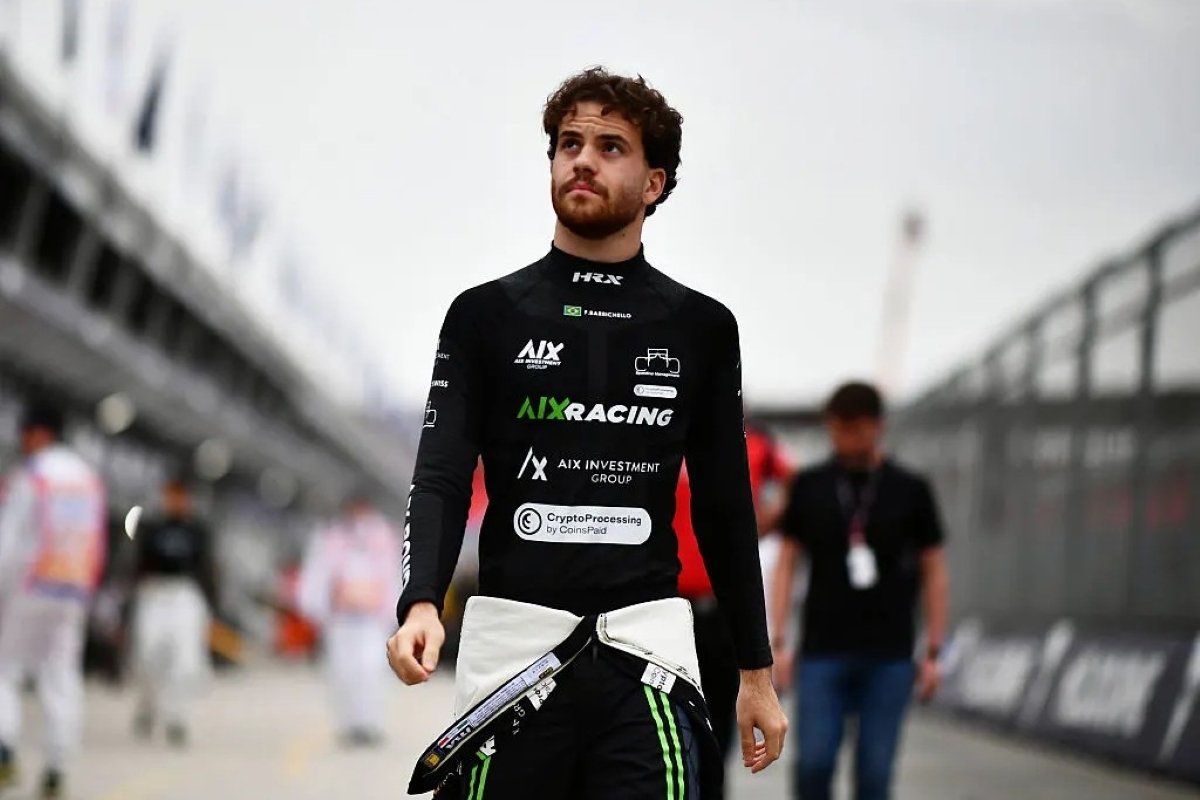
Photo: Formula Motorsport Ltd
After a difficult start to his rookie season in FIA Formula 3, Fernando Barrichello has continued to develop steadily amid the uncertainty surrounding the future of his AIX Racing team.
The personable Brazilian, the youngest son of multiple Formula 1 race winner Rubens, began to show his true potential in the late summer, scoring points at the Hungaroring and qualifying seventh-fastest at Monza.
Formula Scout spoke to ‘Fefo’, as he is universally known, about getting to grips with F3, and what it means to carry on the Barrichello legacy.
“It’s been a very tough season, to be honest. I felt like there were a lot of moments this season where I was doing a really good job and unfortunately things wouldn’t work out,” he says, “but we never stopped working hard and with the changes that were made a lot of stuff improved.
“It’s been a very steep learning curve,” he admits, although many of his problems have been out of his control. “You can just sit down and be frustrated, or you can be like, ‘Okay, I can’t control that, but maybe there is something else that I can try and do’, and that’s been the main focus for me this whole year.
“I’ve learned a lot through this sort of painful time. I had to look at what I could do differently and obviously you still believe that maybe some things are supposed to be different that are not in your control but you can always improve. To be honest, I think there’s been a huge improvement in everything.
“I started to get more and more into the engineering side, the setup; not just driving but trying to understand everything that’s going on and what I needed to do to be quick. I think that makes a big difference and so although it’s been painful, there’s a lot that has been taken from it.
His increased technical understanding meant that he felt that he could start to be “fully involved and really point out what I need from the car. Before this year I always just trusted the engineers and gave them feedback on what I felt but couldn’t really tell them what I needed. I feel that I’m now able to point out what I need.”
Despite the family name, “the fact that I didn’t have the financial backing to be able to test at all [meant] the first time I drove the F3 car was the first time on the weekend. I didn’t have the opportunity to learn behind closed doors so I had to learn a lot of stuff in public with everyone judging me, which really pushed me not to listen too much to the outer noise.”
Although Barrichello had made his F3 debut in a one-off appearance for the same team at Monza at the end of 2025, he was making the huge step up from Euroformula Open for his first full season. While the Spanish-run series retains the ethos of traditional F3, the championship is significantly less competitive than FIA F3, or indeed other sub-F3 categories such as Formula Regional Europe, Eurocup-3 or even GB3.
The step up was “quite big, it’s quite different,” he acknowledges. Less in terms of the performance of the car, but rather “the full weekend structure. [In F3] you do maybe two or three laps in FP and then you’re going straight into qualifying whereas in Euroformula we had two or three nice FP sessions, one hour.
“So, you can go out, just try stuff and get confident but here there’s no time for that. It’s just go out and execute.
“I think that was the biggest difference for me, and I think that the rookies probably all struggled with that the most. We went to Australia, for example, and I did two laps in FP and then straight to qualifying. It’s like ‘Wow! I’ve done two laps around this place and I’m qualifying for my first F3 race, so it’s quite crazy.”
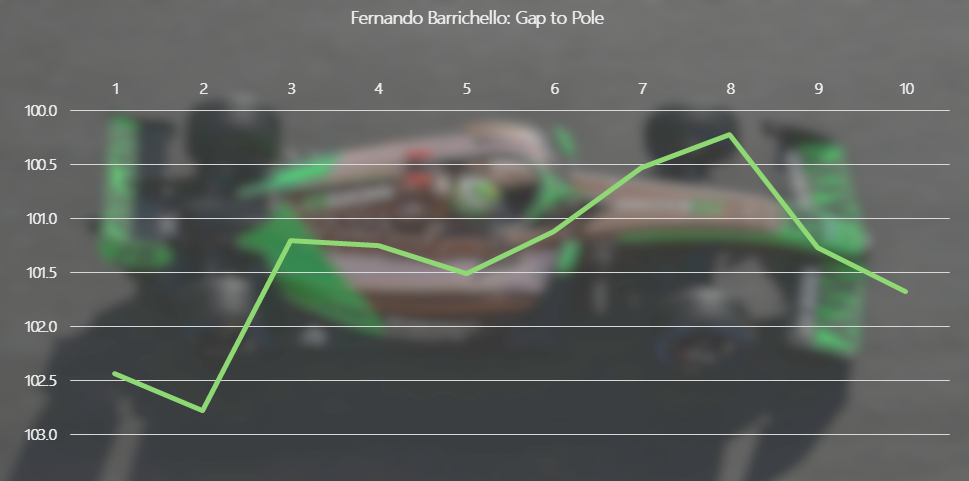
The start of the year, with two straight street circuits after the cancellation of the more traditional environment in Bahrain, was a tough baptism for a driver with less experience than most of his peers. He was over two seconds off pole in qualifying at both Albert Park and Monte Carlo.
He admits that qualifying has been where he and the team have had the most catching up to do.
“I think the race pace has always been our strong suit, but we have been struggling with one lap pace. That’s been the hardest for us to sort of find out.
“For me personally, it was also something that I needed to improve. In the beginning of the year, I felt like that was probably the thing that I needed to pay the most attention to.”
The efforts began to pay off as the championship returned to traditional European venues through the summer. In Hungary he was within 1% of the pole lap for the first time, and then in Italy he held his nerve in the usual cat-and-mouse Monza game of getting, and avoiding giving, a tow to lap just 0.226s (or 0.22%) slower than poleman Freddie Slater.
Though his qualifying improvements rather fell away at the Madring, perhaps unsurprisingly given his earlier street track results, the statistics show that he and the team have clearly been going in the right direction.
In addition to managing the demands of F3’s qualifying format, he also feels that “we were missing in general from the setup and from what we need from the car.
“There were situations where we were like, ‘Man, this is the absolute limit of what we could have done, but we are nowhere near where we want to be.’
“So, clearly something really big needed to change. I think everyone sort of understood that and that’s why the changes started happening.”
Things finally came together at the Hungaroring where Barrichello scored his first (and only) points of the season with ninth in the sprint race.
“Hungary was a very nice one, where we were able to execute a bit better already and with a very different car than what we had previously and then I was able to show what I’m capable of a bit more. Obviously, not exactly where we want to be, but already in the points.”
Alas, when he seemed to have made progress, he was brought quickly back down to ground. He was running just out of the points when he was the innocent victim of an optimistic lunge from team-mate Yevan David on Enzo Deligny into Turn 1.
“I just got taken out from behind,” he laments. “There’s absolutely nothing I could have done. Obviously, it’s very frustrating but that type is something that I don’t lose sleep over because I could have done absolutely nothing differently in that situation.
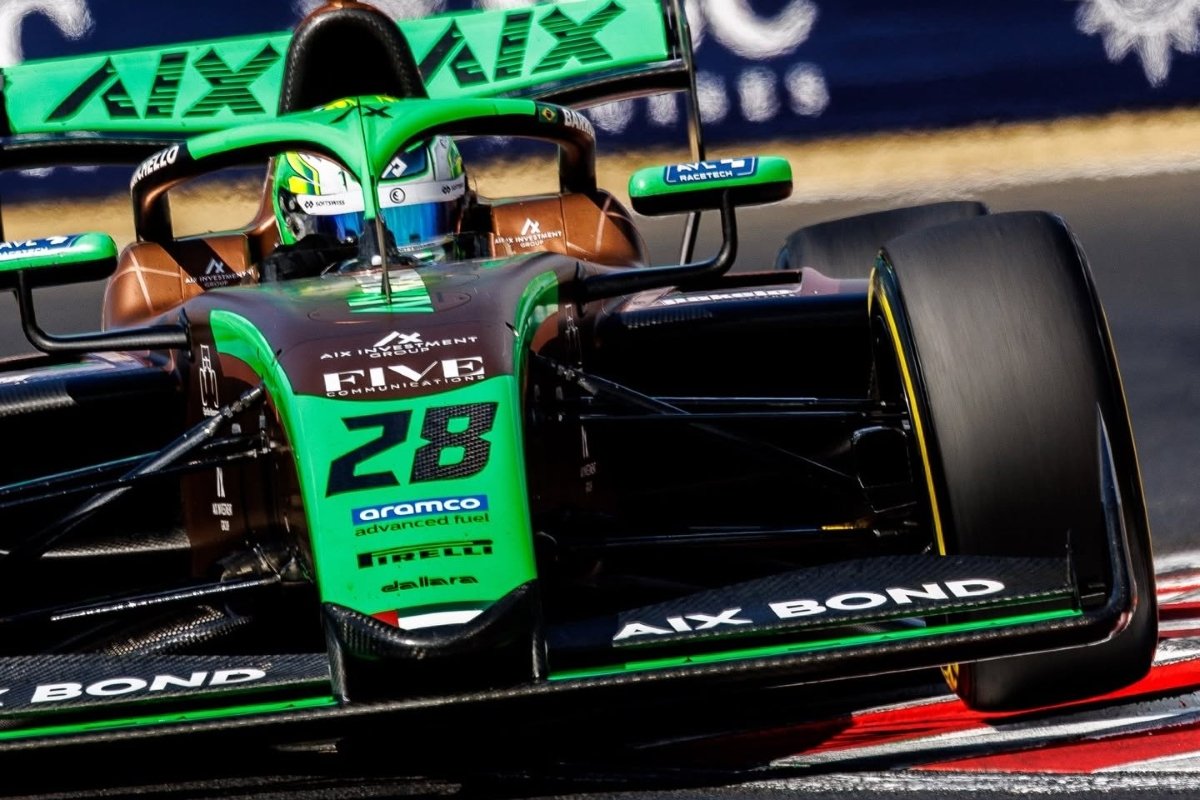
Photo: AIX Racing
“I try to control what I can control and I think Euroformula was a lot of good learning for me and prepared me for this situation although obviously there’s a lot of things that you don’t learn in that situation, especially one lap pace and not having a lot of experience on a track that you have to push and go full out.”
To make matters worse for Barrichello and his fellow Euroformula graduate David, AIX Racing had to make do without the experienced Brad Benavides from Monaco onwards. A succession of less experienced drivers in the third car left the team without its obvious leader.
The hard-working team has also been competing this year against the backdrop of the team’s sale to the new venture co-founded by Lando Norris, LN4 Fusion.
The team has never been the best-funded garage in the pit lane but has worked wonders with the resources available. But the uncertainty clearly affected the owners’ willingness and ability to invest, as Barrichello alludes to when he says that “some stuff in the background that was limiting things to move forward.
“A lot of things ended up having to change inside of the team, which I think unfortunately happens, but once these changes started happening in the background and I think that improved quite a bit of stuff on the car and the working method itself already from Budapest.”
The deal with LN4 Fusion was announced in the days before the Monza weekend, together with a new livery for the team’s cars, and Rene Rosin and Guillaume Capietto were both present in the paddock over the weekend.
Whether the announcement played its part in quelling the rumours around the team’s future, Barrichello starred in Monza qualifying, before letting his inexperience catch him out whn fighting, for the first time in F3, in the leading group in both races.
In the sprint race, he was forced off the track by the subsequently-penalised Brando Badoer as the leaders ran four-abreast past the pits, although Barrichello himslef was given a three-place grid penalty for the feature race for then rejoining the track in an unsafe manner, resulting in a collision with Badoer. To be fair, Barrichello was given little choice as if he had not jinked back onto the circuit he would have been hurtling towards the first chicane on the grass.
In the feature race, his penalty cost him his hard-earned fourth row grid slot, but he was soon challenging his nemesis Badoer again for 10th. On the run down to the Roggia chicane, Badoer edged him to the inside with Barrichello losing control and almost skittling those ahead as they turned in.
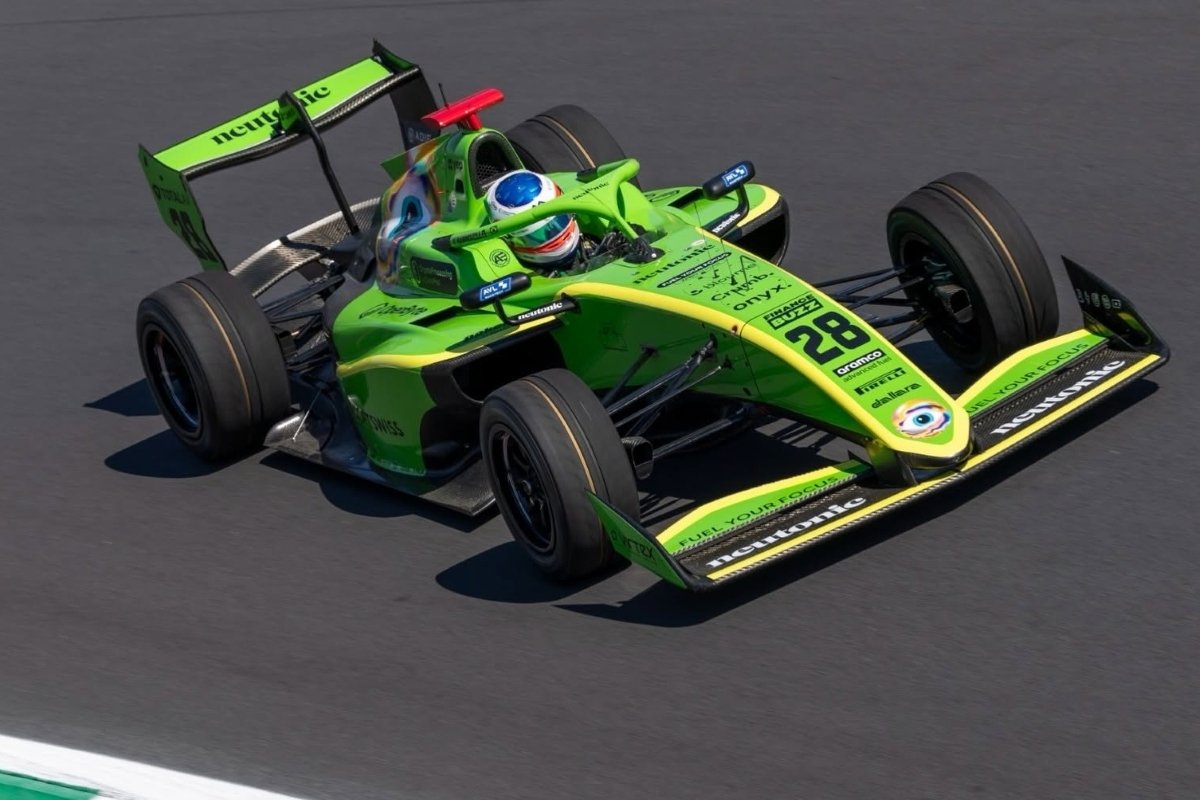
Photo: AIX Racing
Bad luck? Inexperience? Was he just not used to the wheel-to-wheel combat of the F3 pack? Whatever, a potential double points finish had evaporated into another pointless weekend.
Another very important figure onsite in Italy was Barrichello’s father, Rubens, almost 17 years to the day since he claimed his 11th and final F1 win (and still the most recent victory for a Brazilian driver) at the same circuit for Brawn GP in 2009. Fernando proudly carried a new helmet design at Monza, combining his and his father’s colour schemes.
The Barrichello family is clearly a very close-knit one. Rubens is a regular presence at his sons’ races when his own extensive commitments permit. In addition to Fernando in F3, brother Eduardo ‘Dudu’ Barrichello is racing an Aston Martin in GT3 in the World Endurance Championship and IMSA for the Heart of Racing team, while Barrichello senior himself is still giving the young boys a run for their money in Brazilian stock cars.
How much has it helped the younger Barrichello having such a legendary figure in his corner?
“Our relationship is in a really good position,” he says. “Back in my karting days when I started, I would just drive and have fun and jump out and he would do the setup for me and I would just rely on what he knows, because he has so much experience. I would go back in, win some races, go have fun, eat some McDonald’s…
“At that point it was really nice and it just took me a bit of time to realize [everything that he was doing for me].Once I started to get serious, I began to realize that I didn’t know anything that was going on. Once I jumped into the F4s, my dad was still very involved and talking to the engineer and to me.
“It was a really hard conversation and something that was really hard to happen, but unfortunately I had to show him that I needed him to be only my pop. He cannot be my engineer, my driver, coach, he needs to be my father and as my father there’s a lot that I can learn from him, especially with what we were speaking about previously, the setup. Nowadays, he’s my father because I need him just to be my dad.
“I don’t think anyone in the whole world has a deeper understanding of a car than my dad does. I think that’s something that I strive to achieve. I have been studying massively because that’s something that I admire. I worked one year as a mechanic in F4 because that’s the type of knowledge that I want to have because I think he has that knowledge and I think that might be one of his biggest differentials.
“I knew, even though maybe in the beginning it was hard to explain to him, that if he does the setup, it’s probably going to be better than if I do the setup. But when he’s not there maybe I start to lose my voice inside the team because then we’re just relying on what he thinks.
“So, I think I had to go through some worse setups than maybe they would have been if he had done it. But I think that sort of set me up to try and have as much as an understanding of the car as he has, because nowadays we can have this one-on-one conversation at a level basis.
“Obviously, I still have a lot to learn to try and get to his level of understanding, but already be able to like, ‘Hey dad, I feel like a bit more of an open diff would really help me in this situation, would you agree? Or I think maybe three laps is better than two laps, what do you think?’ And then he can give me that feedback.
“We try not to talk too much about racing over dinner but that never works out. So whenever he can be here, he is and I always try to have him here as much as possible. I really, really like it when he’s here and we just feed off each other. We have a lot of fun, so it’s great.”
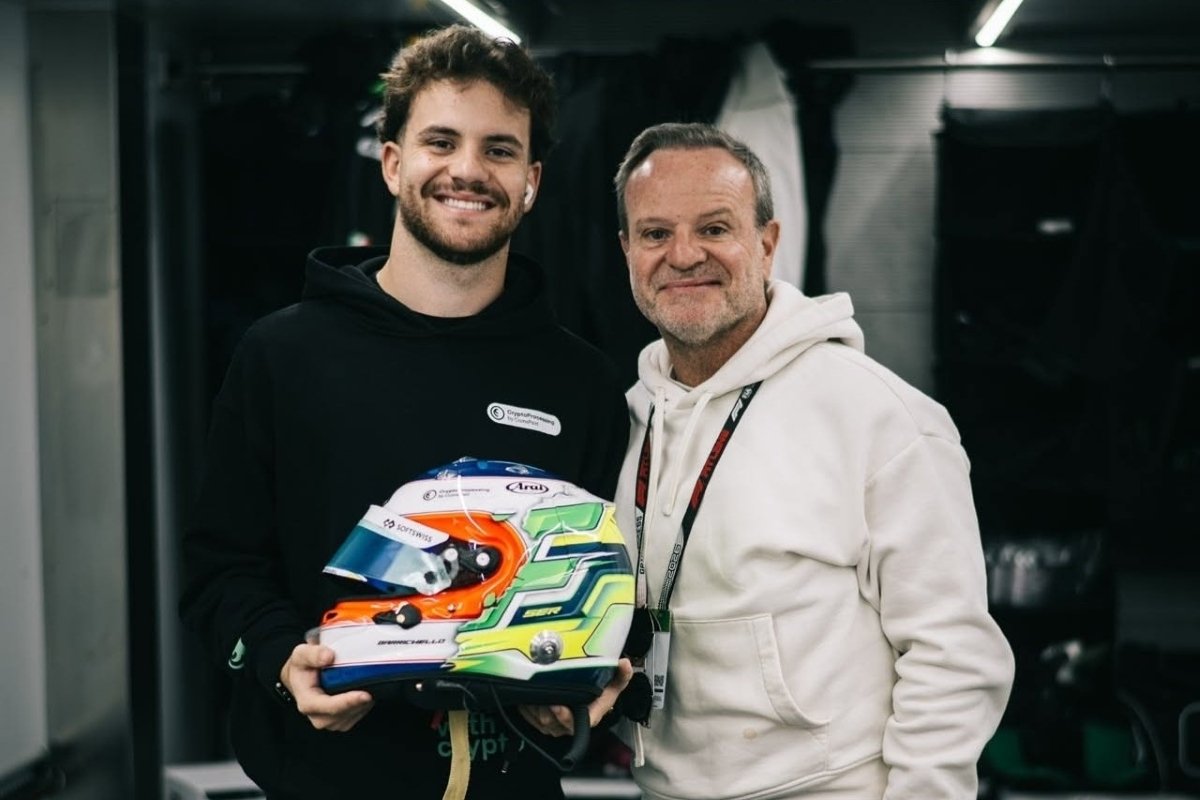
Photo: AIX Racing
I have had the good fortune to interview many second-generation racers, and for me Barrichello sums up the double-edged sword of having a racing legend for a father more eloquently and honestly than most. Was having a famous father a help or a hindrance in his early career?
“There’s been both negatives and positives,” he answers diplomatically. “Throughout my career, I am sure that my dad was able to open some doors for me. But I’m also 100% sure that he can’t keep them open for me. And I’ve always believed that with all of my heart.
“I have to keep them open myself and I need to work double hard because, unfortunately on the negative side, people have a bad preconception of me as someone that takes it a bit for granted and gets everything with their hands kissed a bit.
“When you’re a kid and you see all that pressure people are putting on you and people maybe saying some bad things about a 12 or 15-year-old kid, I don’t think it’s nice. I don’t think the world is nice, but I think that’s how it happens.
“So I think me and my brother learned to deal with that, not to think too much about it and not let it impact us. We just do our jobs. I think my brother is an extremely good driver, I think I’m an extremely good driver and I think all the opportunities that we are now getting at this professional level is because we’re good drivers and we work extremely hard because we really want to also prove to ourselves that we are earning the things that we are getting.
“I try and just focus a lot on the many positives because the experience that he has and the things that I’m able to maybe chat to him and extract from him are great even when he’s not here. He wasn’t in Hungary and that was our best race and just being able to chat to him and also just celebrate together. I’ve had some wins where my family wasn’t there and to be honest it’s not the same. Having good results with your family there is different because you are doing it for them as well. So, whenever I can have family around, I’m just double happy.”
Barrichello is honest enough to admit that “there’s still a lot of room to improve; more understanding, especially on the engineering side. I try to really tick all the boxes and do everything in my power.
With the team under new ownership, who surely have their own bold plans, his future is as yet uncertain. Twenty-eighth in the standings, ahead of just three other full-season drivers, hardly looks like the CV of a future world champion.
But considering where Barrichello came from, the convulsions the team was going through and his obvious progress and determination to continue learning, not to mention the family behind him, he more than deserves a second season at this level to really show what he can do.
And as a driver, but maybe even more as a person, he is a worthy keeper of the Barrichello family flame.