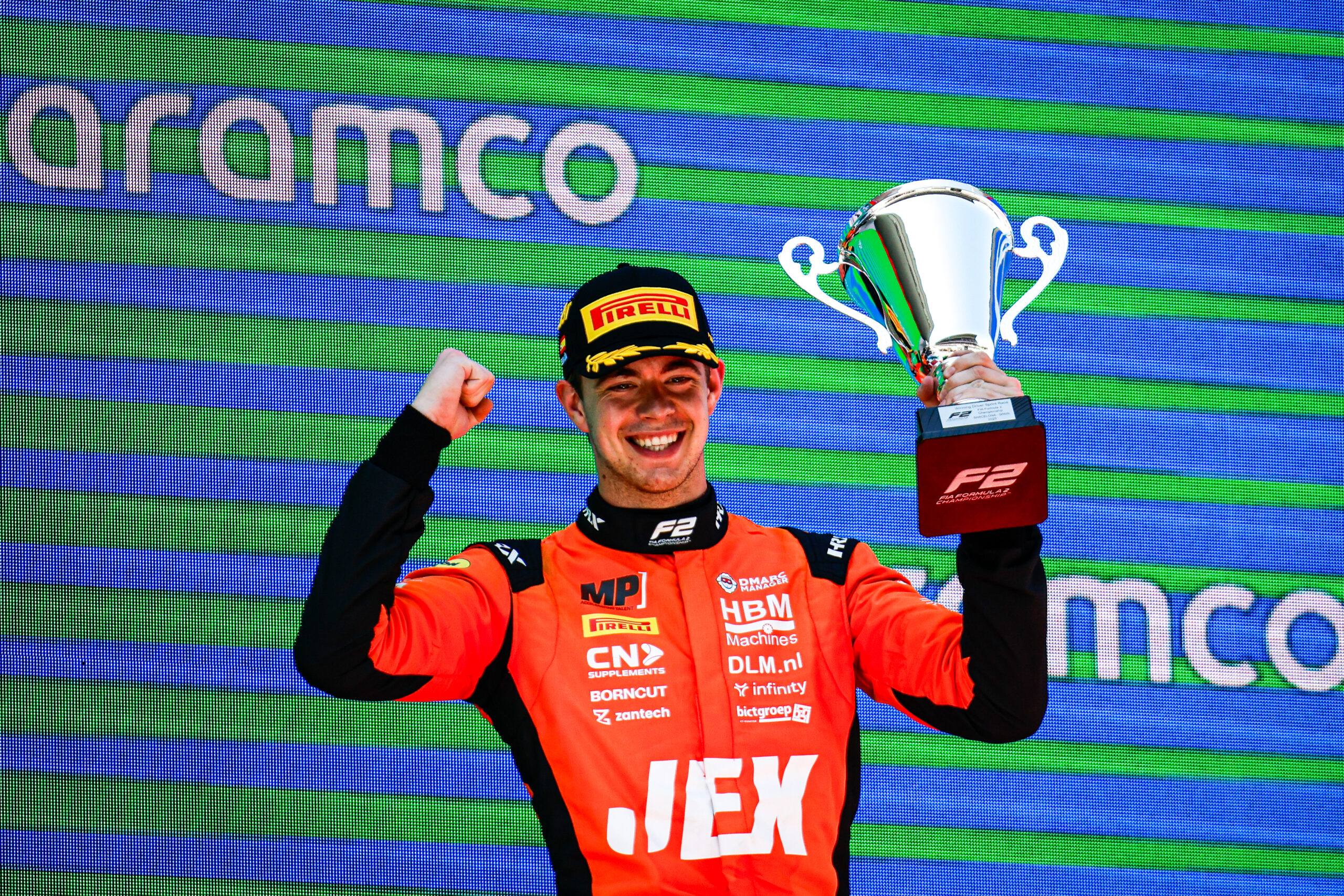
Photo: @datanromar
Financial support – or a lack of it – defines many if not all racing careers. Richard Verschoor has been on the negative side of it for years, but that is no longer the case thanks to well-structured self management.
In an era where most drivers arrive at the race-track surrounded by their families, managers, driving coaches and physios, Richard Verschoor is accompanied only by a couple of friends if at all. He has earned himself a spot on the list of drivers whose trophy cabinets would feature more silverware if their budgets had allowed for better opportunities.
The Dutchman became 2016 SMP and Spanish Formula 4 champion in a maiden single-seater season that gained him Red Bull backing early on. The following campaign in Formula Renault did not live up to the expectations, however, and he left the Red Bull Junior Team, which put his whole career at risk. But that was not the only time he came close to quitting. “Before winning the Macau Grand Prix in 2019, the 2020 season looked impossible,” Verschoor says. And there was also little hope left after he lost his biggest sponsor in the second half of 2021.
Still he never gave up and kept finding ways to be on the starting grid one year after the other. And after four seasons as Formula 2’s underdog, he earned the opportunity to fight for the drivers’ championship in 2025. This has only happened as a result of a lot of hard work, closing deals and establishing reliable partnerships, which Verschoor has reflected on in conversation with Formula Scout.
“I didn’t have a choice,” he says. “It was either I tried to make something of my career and what I love, or I stopped. Because when I got dropped from Red Bull basically there was no way to continue.”
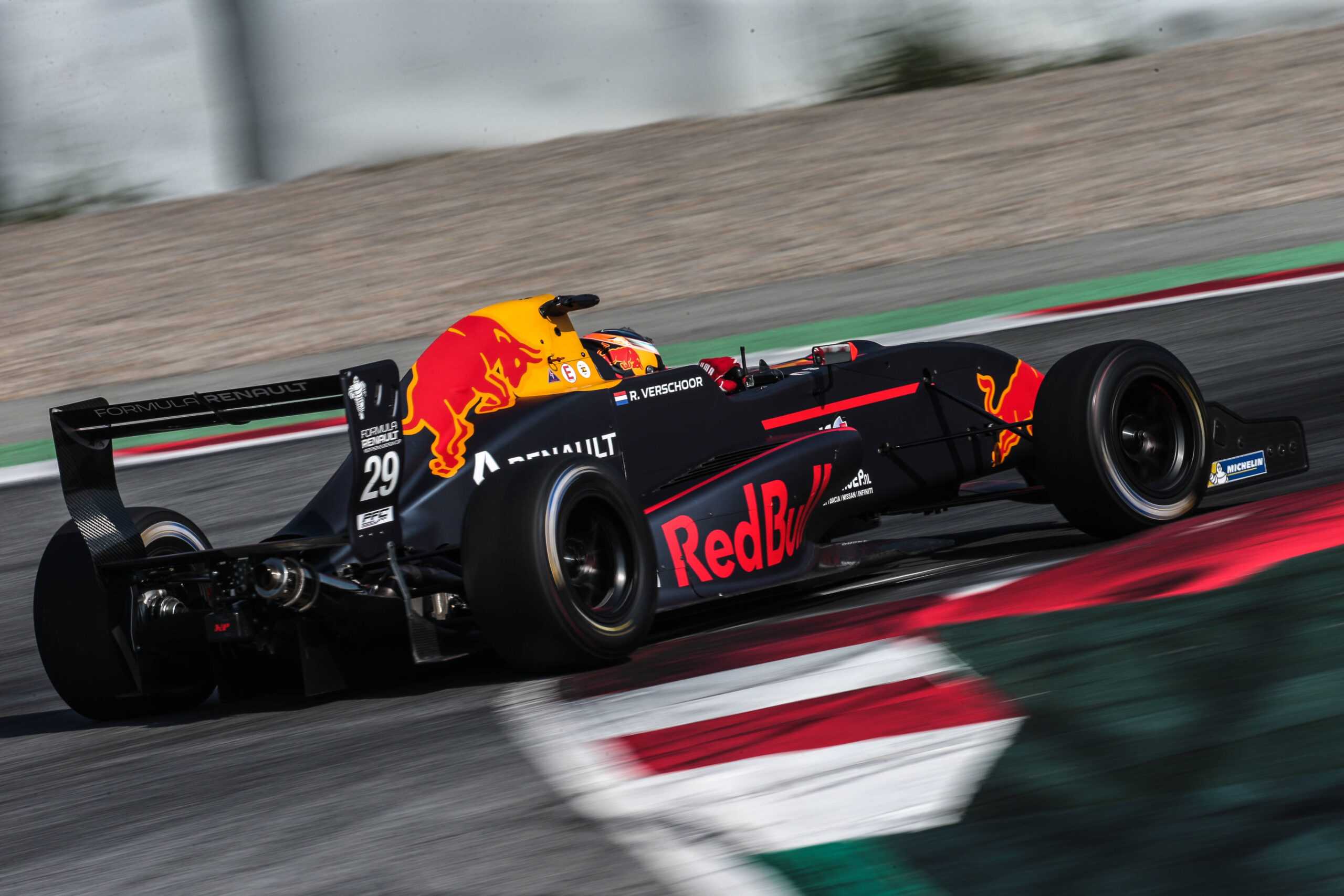
Photo: Red Bull
At this point, 17-year-old Verschoor decided to take his destiny into his own hands and became his own manager. He started contacting potential sponsors and eventually gathered enough support to line up a solid racing programme for the 2018 season. Eight years on, he is “very proud and happy” of what he has achieved.
“In the beginning you start with one sponsor, two sponsors, three sponsors, and now I have 34 sponsors or partners. I always say partners instead of sponsors. That is quite a lot; 34 different companies that are supporting me. I think that’s quite special, and I think I have more sponsors than some F1 teams.”
“Always be yourself and always be sure that whatever you say, you do” were the first lessons Verschoor took from his father in the early days. Returning a bit more than what is expected is also a must. It is all about creating a partnership where both parties work together to reach common goals. Go beyond just closing a sponsorship deal.
“You can never expect anyone to do something for you without doing anything in return. I always try to give them back as much as I can or at least I try. And of course sometimes that goes better than other times,” he says.
“It’s very easy of course, if someone gives you money, to say thank you. And what happens quite often is that then the drivers never really reach out to them again or are not grateful. I think that’s something very important. You have to be grateful for everybody that has helped you. Even if it’s 10 euros – to exaggerate it a bit. Everything helps. And I’m very grateful that my partners are supporting me this way because without them I wouldn’t be driving.”
Verschoor has been able to fine-tune his partner-seeking skills over the years. It is crucial that future partners hear about the project straight from the horse’s mouth. That is why he is reluctant to have a manager doing deals for him even though the task is highly time and energy-consuming.
“I’m not sure how many drivers do sponsorship by themselves. I heard many times that someone does it for them. But that’s the first thing I would exclude because I have learned that that doesn’t work,” he says.
“If you have a dream, you have to tell the person that has the same dream with his company yourself. If you don’t say it yourself, it has no emotional connection. And in the end, it’s not only about the money and what they get back. It’s also about the connection with the person that you’re speaking to. Because I think that’s where it starts. If he wants to help you, that’s already 50 percent of the deal.
“One strategy that is still helping me right now is dividing the amount that I need in many different kinds of sponsors. Because I need a lot of money and I can get to that amount of money because I reach out to many, many companies. And they are from different fields. In that way I can connect all of them because maybe they can do business or they have a client who can help them.
“And it is also risk-spreading. Because if one doesn’t pay out of 34, it’s less than if one doesn’t pay out of one — because then I would have no money at all. Risk-spreading is very important, but also creating the connection between partners is something I value a lot.”

Photo: Formula Motorsport Ltd
The popularity of Formula 1 has increased worldwide and particularly in Verschoor’s native country in recent years, and that has had a direct impact on companies’ willingness to get involved in motorsport. Either in F1 itself or in other series, several different opportunities arise for both business-to-business (B2B) deals and business-to-consumer (B2C) exposure.
“Ever since Max [Verstappen] has been so successful, the racing in the Netherlands is much more popular,” Verschoor admitted. “A lot of companies want to go to Zandvoort or other races with their clients or with colleagues.
“And of course that helps as well because sponsoring F1 is very expensive. Sponsoring F2 is also expensive, but less expensive. I think that has definitely helped me that the popularity of the sport has been growing. But also the good thing is I really have something to offer. Because it’s super cool to be present at an F1 event. There are so many people. It’s really something special, and also there is so much social media attention there.
“There is so much to offer to a sponsor that it makes my life to find a sponsor easier. I mean, if I were looking for a sponsor for karting, it would be much more difficult,” he says.
Verschoor’s current position of financial security comes off-the-back of years of struggles, with lots of lessons learnt the hard way. Having to secure the budget for the next season over the winter makes finding a competitive seat more difficult and vice versa. On one side, he had to convince teams that he would eventually obtain the funding. On the other side, he had to convince potential partners that his racing programme would be worth the support.
“I think this is the toughest part of all of it,” he confesses. “Because I have always had to sign the contract before I’ve gotten all the money from my sponsors. So I have always taken quite a risk. And now I’m very happy that I have very trustable partners that support me and help me.
“It’s not always been easy. I have been feeling a lot of financial stress. If people are possibly not paying, it’s always a bit difficult to talk about. Because I cannot say much about that if a sponsor is not paying because it’s bad for my image and for their image.
“Sometimes things don’t go so well and what I’ve learned from all of it is to be very strict on the agreements that you make and always put everything on paper and in a contract. Even though there’s many people that you trust and sometimes you feel like you can trust, but I have had a few occasions unfortunately where it didn’t go as I planned and as I thought I agreed with them. So that’s for sure an important factor.”
Being always on the edge has developed a fear for damage that is still there nowadays. “Not for the risk of injury but for the risk of invoice.”
“To be honest, when I race, I don’t really think about it. If I see a gap or if I take a risk, I don’t care. Because at the end of the day, if I don’t do that, it’s better not to race. But once it happens, for example at Monza [qualifying], it’s one of the first things I think about. Because not only I ruin my whole weekend, I can also expect an invoice. So it’s always a bit of a game. And I think for me, it will never go away.”

Photo: Red Bull
Although self-management is highly demanding, Verschoor is adamant that his on-track performances have never been compromised. Nevertheless, he recognises that he wouldn’t mind reducing the amount of activities currently featuring in his schedule. In fact, he has been helped with his racing programme negotiations for 2026, but the rest is fully steered by himself.
“I’m so much more complete as a driver now because I do everything myself. I think I’ve been maturing a lot in the last years, months, because I simply have to do everything myself and I’m really happy with that. And I would recommend it to anyone.
“I’m so dedicated to my sport and I would give up everything to win because it takes me so much work to be there. So it’s not that I just sign a contract and that’s it. When I sign the contract, my hard work starts. And in-between I do the usual driver stuff, which is working out. But for the rest, I’m working on getting everything done.
“To be honest, if I could choose I would like to do half of what I do now. I wouldn’t like to do nothing because I think it helps me to stay sharp and develop myself as a person instead of as a driver. But at the moment it’s full push everyday, and sometimes it’s a bit too much.
“Just as an example. Today I was filming with a sponsor at the karting track, then I had a meeting in the car for one hour in-between. Then I went to film at MP Motorsport with another sponsor. And now I’m on the way to the gym. Tomorrow, I work out again in the morning, then I go to film again in Amsterdam. And in the evening, I have a sponsor event. On Thursday, I go to the simulator. On Friday, I have another sponsor event, and in the evening I go on TV. And then on Sunday, again I have a sponsor event in the morning. So basically I’m trying to do a lot for my sponsors.”
Verschoor enjoys getting involved with his partners to help them reach their targets, forging a strong bond. He seizes every opportunity to learn new skills and apply them to create value across different fields.
“I’ve been working with so many different kind of companies. And basically what I am always doing is also thinking with them about their marketing strategy. For some of them it’s more exposure, other ones just want to bring the clients to the track or to an event. And I can also help them with those kind of things. Because I’ve done that so many times I know exactly what works, what doesn’t work. If you organize an event, you want to get potential clients there. ‘What is the way to reach out to them? Is it nice by video? Is it nice by email?’ There’s many things to think about when you do a partnership because it’s not only about someone to place the sticker on the car,” he explains.
“The sticker is the validation of the partnership. But everything you do around to activate that sticker, that’s the most important. The sticker is the least difficult part of the whole partnership.”
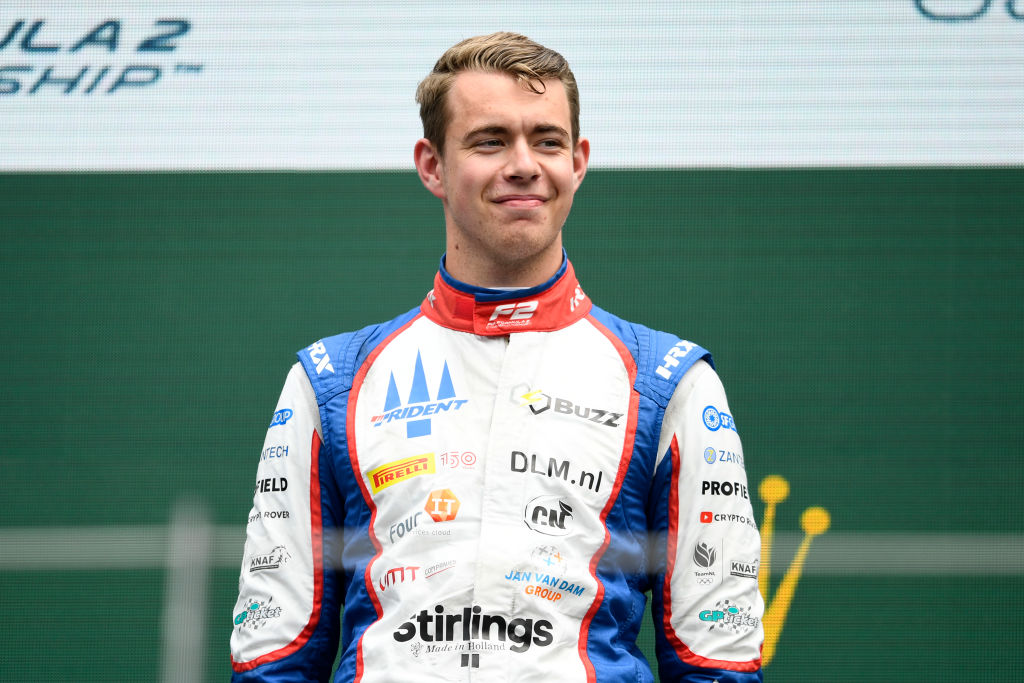
Photo: Formula Motorsport Limited
One could think that having proved his speed across four seasons with midfield teams in F2, it was already time to move on. However, Verschoor felt that the stellar performances achieved along the way were not enough, and wanted to have a last crack at the championship.
With the funding secured on time, he could properly prepare the 2025 campaign with series frontrunner MP, already starting with the team in the last two rounds of 2024. The title escaped him in the end, but he came third in the standings. Along the way, he has amassed two feature race victories, two sprint wins and two more podiums. And now he has been signed by McLaren to its driver development programme.
“I don’t have the feeling that what I’ve showed in F2 before this year has been the way it should have been. I feel like I could have performed much better. Or many times when I did perform, the results were taken away because of disqualifications. And therefore, in the end the points were not good enough.
“I finished 11th, 12th, ninth, eighth. If you count the points of course without disqualifications. Of course a crash or a mistake, I don’t count those. But just disqualifications, I should have been sixth in my first year with Trident in 2022, without the disqualification in Austria. That would have been quite a good result. But I was 12th because of it.”
Additionally, Verschoor addresses the topic of why some talented drivers keep returning to an expensive series like F2 instead of looking elsewhere after one or two years in the championship.
“Some people think ‘fine, if you have that kind of budget spend on another category and you have the same budget’. But it doesn’t work that way.
“All the people that gave me this budget, I’ve been selling my dream to become a F2 champion and potentially an F1 driver. So it’s not true that I would have had the same budget if I would have done another category.
“It’s much harder to find budget for IndyCar, for example. Because which Dutch company has interest in the US? Not many. A few, but not many. So it’s much more difficult than what many people think.”
In the end, when drivers rely on sponsors’ money to earn a race seat, the series chosen very much depends on the funders’ interests. Otherwise, the budget would not be available.
Some may well doubt the value of results after so many years in the category. However, experienced drivers still have to prove themselves every time they are out on track against highly talented and very well prepared rookies in what is an unpredictable championship. Thus, there is still value to those victories that will help enterprising drivers like Verschoor to “do deals” in the future.