Photo: Formula Motorsport Ltd
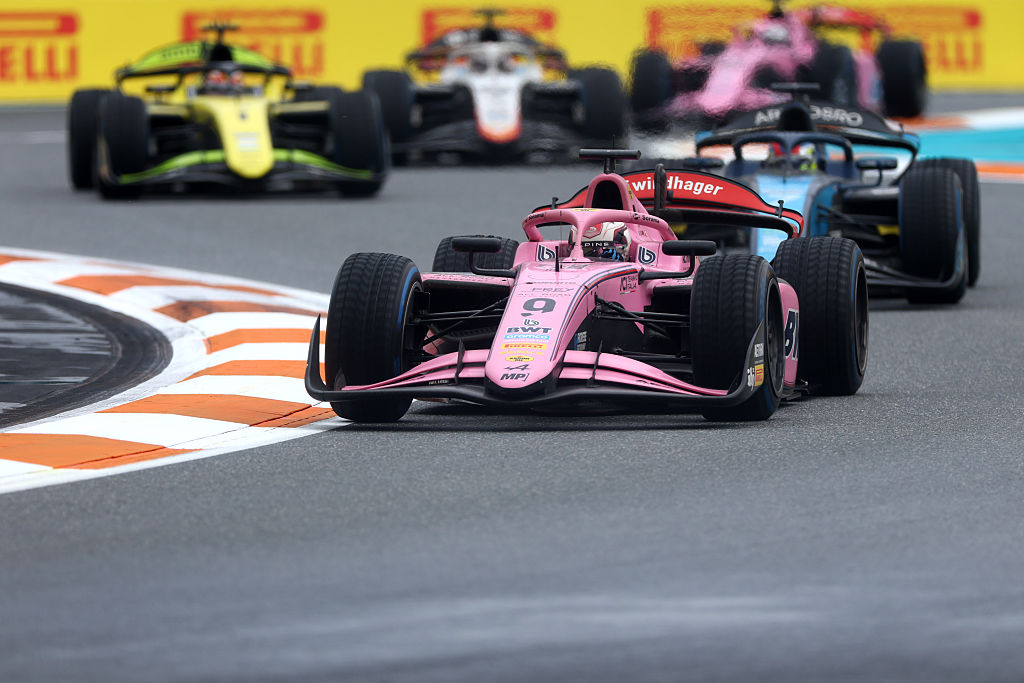
Gabriele Mini finished Formula 2’s Miami debut the happiest having secured his first career victory in the feature race ahead of Dino Beganovic and Rafael Camara, but questions arose around two of those results.
Suspicions surrounded the race’s first safety car intervention, where race control instructed drivers to follow the safety car through the pitlane. Mini entered the pits having already passed the bollard that marks the entrance, after Camara had missed the pit lane entirely, continuing down the main straight behind then race-leader Kush Maini. Both would be investigated, but avoided penalties.
Race control issued its message just as drivers were heading through the final corners. “My call was very late,” said Camara. “I got it a bit later after I passed the pitlane [entry] and I was also a bit confused as to what Kush and Martinius [Stenshorne] were doing.”
While Maini and Camara continued round onto the start-finish straight, Stenshorne, who had been running in second position, had entered the pits to serve a drive-through penalty.
The stewards said that teams had been informed by turn 17 that drivers were to head through the pitlane, with the final two light panels at the side of the track illuminated to show this. They also said that race leader Maini was approximately 50 metres away from the first of these panels as the message was conveyed to drivers.
Despite this, they opted to give Camara a warning instead of a time penalty, their reasoning being “no driver benefited nor was harmed”.
“The track condition was very wet and there was significant spray reducing visibility although it appeared from the drivers onboard camera that the panels were visible. There is no way for the stewards to know when the drivers were notified by radio of the race director’s instruction to enter the pit lane. Some teams may react quicker than others and it is impossible to know what other radio traffic may affect how quickly the message can be delivered to individual drivers.”
“The driver explained that he got the message from his engineer after he had already passed the bollard and given that he knew he was not to cross the solid line he chose to stay out.”
Mini’s case was slightly different. He initially avoided the pit entrance but, upon instruction, entered the pits, missing the bollard in the process. Drivers are specifically instructed to enter to the right of this bollard to ensure maximum safety.
“I got told right before so when we would make our move to go into the pit,” explained Mini. “I didn’t want to hit the bollard so went after it, I thought it was still the safest option not to go onto the grid incase there was a car stalled.
“I didn’t know what had happened in that moment, I just got told to follow the safety car into the pit lane but there was no safety car. I wanted to see what the guys at the front were doing and it was half and half so I just stick to going into the pitlane. I went late because I got the call late.”
The MP Motorsport driver felt it would have been “harsh” if he had been penalised after he did all he could to ensure the instructions were followed. “I think it would be harsh because I didn’t even stop as it is a safety issue.”
According to the stewards, Mini explained that he “got the call very late from his engineer and up to that time had only understood that the signals on panel 19 and 20 were for him to stay to the right. Once he had a clear instruction to enter the pitlane he determined that it would be more safe to ignore the white line and do as instructed as opposed to staying out.”
They added: “While the driver contravened Appendix L he did prioritise safety and followed the race director’s instruction as he understood it. No driver benefited nor was harmed by this action.”
The main reasoning behind the stewards’ decisions remained that the drivers didn’t gain an advantage and that their positions were correct come the safety car restart. Both drivers gave valid reasoning for missing the pit entry with the safety car call coming towards the end of the lap.
Whether race control needed to release the instruction earlier is another question. Had marshals been on the track and not aware, the outcome could have been different with the significant spray making it harder to see people on track.